As I was packing my things and preparing to leave, I found myself a bit surprised that for all that I identify with East Asia, I haven’t been to any East Asian countries outside of China. Inevitably, everywhere I go, I’m identified, often quite vocally and unsolicitedly, if not as Chinese, then Korean or Japanese. Now, I finally get to see these countries that strangers so often attributed me to.
Now here at the end of the trip, what can I say I understand now about the region that I didn’t before? In terms of deep historical or cultural understanding I can’t claim much. Most of the time I was too preoccupied browsing and eating to let myself simmer in the local history. Two things however perhaps left specific impressions.
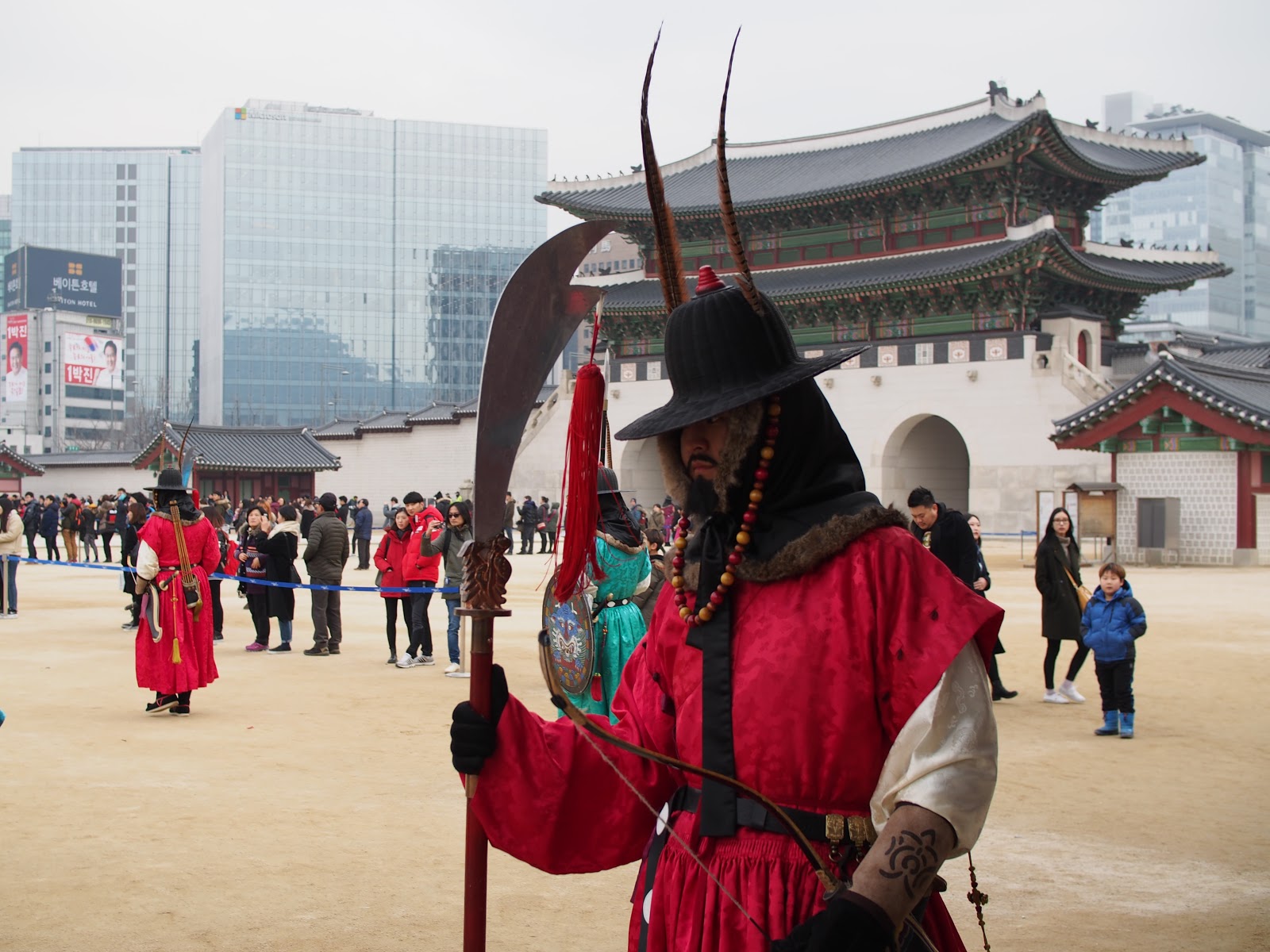 |
| Changing of the guards at the Imperial Palace |
1. I was always vaguely aware of the historic centrality of China to surrounding countries culturally and politically. My dad’s predilection to wax poetic on China’s status as the Greece and Rome of Asia has finally had its effect, so much so that I was giving the same speeches almost verbatim to Kalie as we saw evidence of Chinese influence in Korea and Japan. However, being in these actual countries, it was incredibly striking how ubiquitous “Chinese things” were. Japanese signs were almost all in Chinese script, and the script could also be found in the more historical Korean buildings like the Gyeongbokgung imperial palace. We were surprised to find out that Eric’s mom (who grew up in Korea and to my knowledge, has no Chinese heritage) knows Chinese. Apparently, fluency in Chinese was a common part of the education of the Korean upper and middle class, seemingly similar to how the medieval European nobility knew Latin, or how the nobility of early Britain spoke French to each other. Lastly, outside of language, so much of the religion, rituals, foods, practices, and even art we found in each country had some sort of link to China. The Zen Buddhism that so deeply informs Japanese Shintoism, China. The matcha tea, which makes up the centerpiece for the beautifully elegant tea ceremonies central to the education of Japanese samurai, China. Gorgeous ink landscapes of mountains and bamboo forests in the Samsung art gallery all took their artistic cues from schools of painting from, you guessed it, China.
 |
| Mindori echika, Ikebukuro station |
2. Okay so before I dig in too deep tooting the horn for motherland China, observation number 2 is just one example of why despite centuries, perhaps millennia of cultural hegemony, China is not always number 1. The Chinese language has changed remarkably little over thousands of years. It is one of the few character-based languages left in the world: a memory-intensive language without a phonetic alphabet in which one cannot sound out words one does not already know. The Korean and Japanese both were heavily influenced by Chinese, and I had naturally assumed that they are also character-based. So my mind was blown when Eric taught me how to write Korean on my phone in about 20 minutes over lunch. Apparently Japan was in on the innovation too. After hundreds of years of borrowing varying amounts of burdensome Chinese, someone in both countries decided “hey this really sucks, we should make phonetic syllabaries.” Good job unknown Korean and Japanese innovators, you’ve accomplished hundreds of years ago what a country with almost a quarter of the worlds population couldn’t do over the entire course of human civilization.
 |
| Cat cafe cats are serious cats |
As for my actual travel experience, I can’t help but to remember my experience as an exercise in contrast between the two countries. Spoiler alert, Japan wins in my book.
Weather: Tokyo and Kyoto both had relatively mild winters. We enjoyed sun-filled days well in the 40s and 50s, days that made for lovely morning runs around the imperial palace, strolls through verdant bamboo groves, and paired well with urban exploration. Seoul was freaking cold. Google deceived me to expect days in the 40s, instead it was subfreezing and bone-chillingly frigid. I think back to huddling my way through the DMZ tour, and rushing through any notions of taking in the sights of the traditional Hanok village neighborhoods in search of the next warm cafe. Winner Japan.
People and culture: here I may have suffered from lack of better planning for Korea. I simply didn’t have very much on my list of things to do. The things we did partake in underwhelmed. The Gyeongbokgung imperial palace felt like the JV version of the forbidden palace in Beijing, and the Samsung gallery had some cool historical Korean crafts but my appetite for porcelain is rather limited. My deepest impression may have been a truly bizarre 20 minute tourist video at the DMZ tour. The tour itself was pretty silly, consisting of looking at a barren landscape that is the 38th parallel and crawling into a featureless tunnel to see another tunnel that North Koreans purportedly dug in preparations of an attack on Seoul. The crowning jewel was the video, a shameless and confusing piece of South Korea propaganda that managed to actually make me sympathize temporarily with the freaking North Koreans with its shamelessly jingoistic language. The video simultaneously demonizes the North Koreans for their aggression, promising to respond in force in kind, but then also praises the cause of peace and reconciliation, promising a smooth path to reunification. The weirdest part was an abrupt pivot to nature documentary halfway through, when it starts to catalog the wondrous wildlife diversity that’s proliferated in the midst of this armed standoff. Cognitive dissonance peaked when the narrator culminated with “may the DMZ live on forever!!”… Certainly a confusing message paired with the earlier promise of reunification.
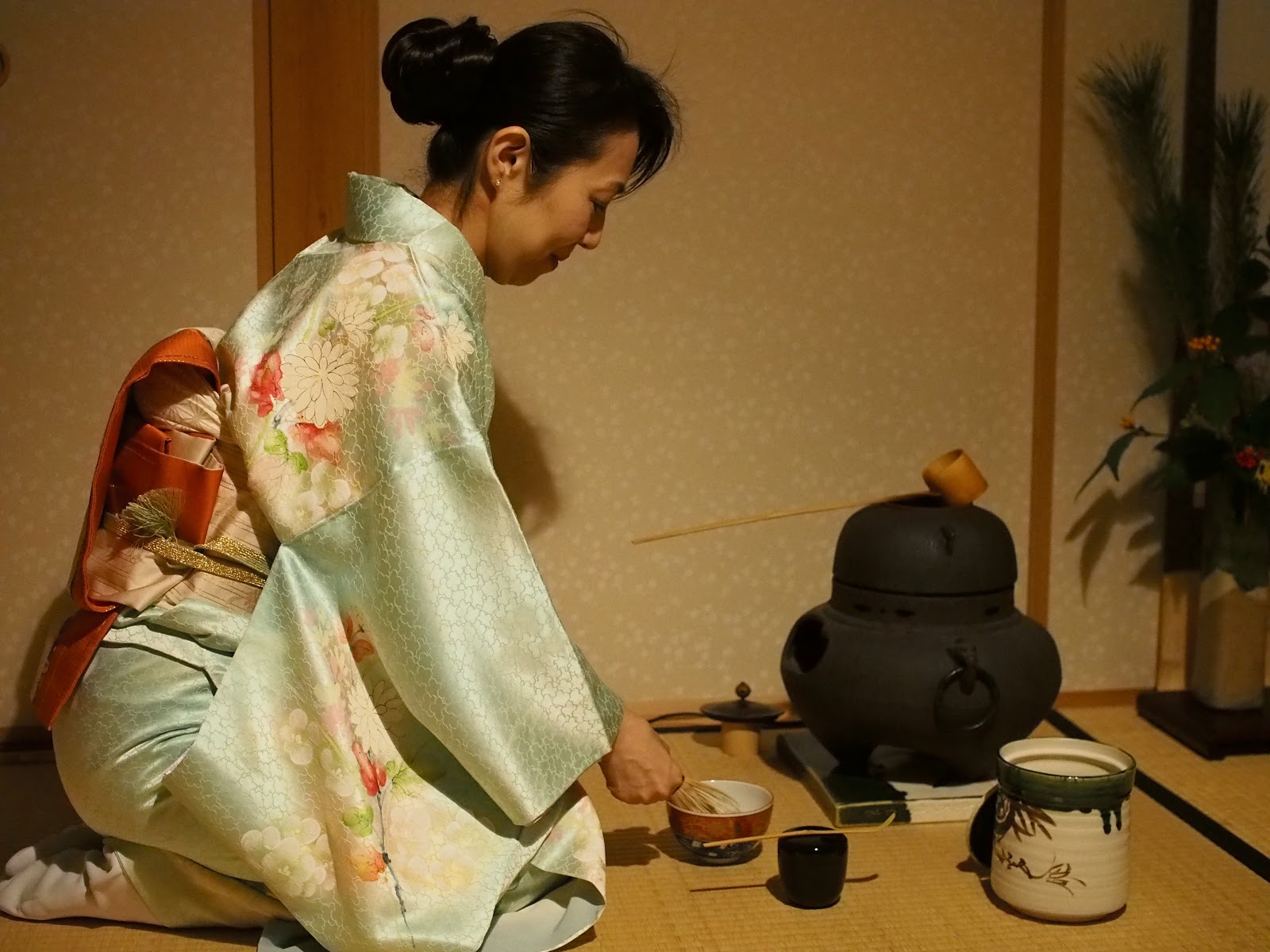 |
| Matcha tea ceremony in Kyoto |
Japan was in a word spectacular, in the sense that there was an embarrassment of riches in cultural spectacles. The home of Miyazaki proved itself the undisputable world leader in cute animal or animal-like creatures (read Pokemon, Totoro, etc). It’s also the home to Harajuku (of Harajuku girl fame), and impeccable street style. I was especially impressed with the haircuts there. Haircuts in China tend to be careless and unattractive, and those in Korea are fashion forward, but they are all the same bowl cut. Japanese people clearly care about aesthetics, and walking around Tokyo made me excited about the different things one can do with your hair as an Asian dude. Winner Japan.
Food: last but not least. I was really excited for Korea food but it fell a bit short of my expectations. Sure the kimchi was tops, and the street food culture was delightfully robust, but among my favorite meals in Seoul was New Year’s Eve dinner when we had Indian food in Itaewon. Also not to mention, my willingness to try street food in the local market resulted in a quick but severe bout of projectile vomiting on my last night there. Enough said.
 |
| Robot restaurant show |
Japan on the other hand, delighted at every meal. It’s not just the abundance in world class fine dining here, but for me I loved the fact that walking into almost any random eatery, you’re guaranteed to have a super solid meal at prices I found much cheaper than my expectations for Tokyo fare. My sampling of the Japanese staples (ramen, curry, sushi, etc) were all excellent. One especially enjoyable meal was my first and only helping thus far of traditional style soba. The minimalism was striking: cold buckwheat noodles in a straw plate, add mushed daikon and sliced scallions, mix with soy based dipping sauce, eat. I’ve always found the notion of balance in cuisine to be difficult to grasp, I’m usually one for bold obvious flavors, but eating that bowl of noodles I felt like I finally got why balance in food can be awesome. There it is folks, a clean sweep.
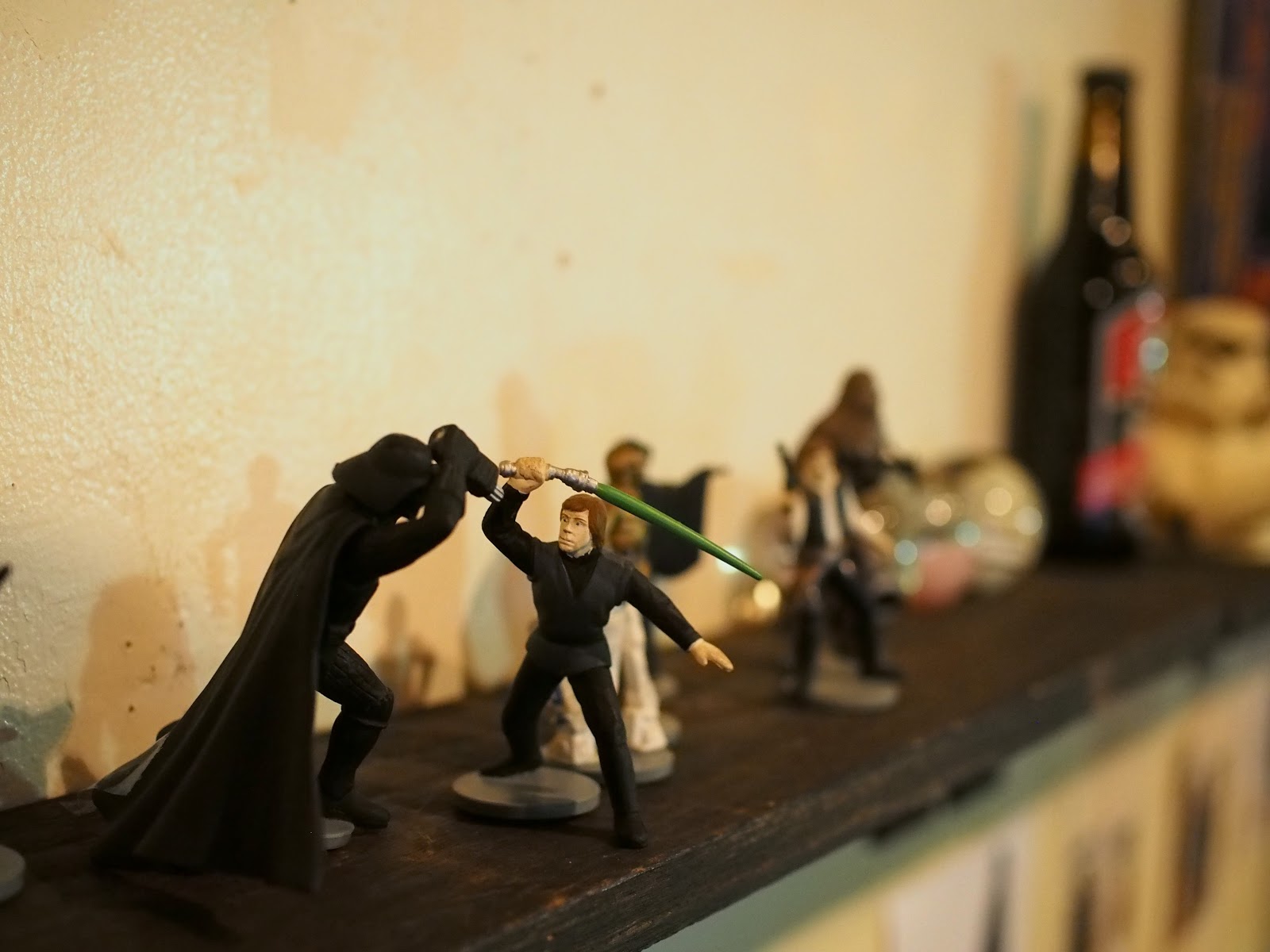 |
| Star Wars themed bar in Golden Gai |
 Jack Wang